In Italy the packaging EPR register was not open at all in August; in Poland sellers report a six-month wait for a number. That is why marketplaces are not enforcing — there is nothing for them to check. But you need an authorised representative in every EU country you supply end customers in, today, and that obligation does not wait for any marketplace.
Three weeks after the 12 August 2026 deadline, one simplification is going round among sellers: the marketplaces are not dealing with it, so there is no rush. The reality is more complicated. No mass delisting has happened anywhere — but you must have an authorised representative in every EU country you sell into, today, and that obligation does not depend on how fast any marketplace moves.
It is not that marketplaces do not care about compliance. For a large part of the market the deadline was practically impossible to meet.
Marketplaces are in the same position as sellers: they cannot enforce a number that physically cannot be obtained. Enforcement is therefore concentrated only where the infrastructure has been working for years — in practice only in Germany, where Amazon has blocked listings without a LUCID number since 2022, under the national VerpackG, not because of the PPWR.
That is not a reason to relax
Once the registers in individual countries clear up — and in some of them it is already happening — marketplace enforcement can switch on overnight, with no further warning.
The same pattern holds across platforms: the rule is usually clearly stated, but the enforcement itself is uneven and depends heavily on whether the country has a functioning register.
| Marketplace | What it asks of the seller | How it enforces today |
|---|---|---|
| Amazon | An EPR/PPWR number separately for every country of sale | In Germany it has long blocked listings without a number (VerpackG, since 2022). Outside Germany it tends to warn and collect numbers through Seller Central rather than delist across the board — we have no confirmation of that. |
| Kaufland | The number entered in the Seller Portal, EPR-Compliance section, separately per country | It has a written rule that without a number the offer must be hidden. That is a stated rule, though, not a confirmed mass action. |
| Allegro | An “EPR PPWR/BDO” number in the account settings | Without a number the field does not show on the offer, which formally puts the sale outside the rules. Allegro has issued no official position on blocking accounts. |
| bol.com | Registration with Verpact (NL) or Fost Plus (BE) | For batteries and electronics it confirmedly blocks category assignment without proof. The same approach is expected for ordinary packaging, but that is not publicly confirmed. |
| eBay | An EPR number for every country where the seller counts as a packaging producer | Its seller help states that without a number it may hide the listing from buyers in that country. eBay Germany was actively collecting numbers even before the deadline. We have no confirmation of mass hiding. |
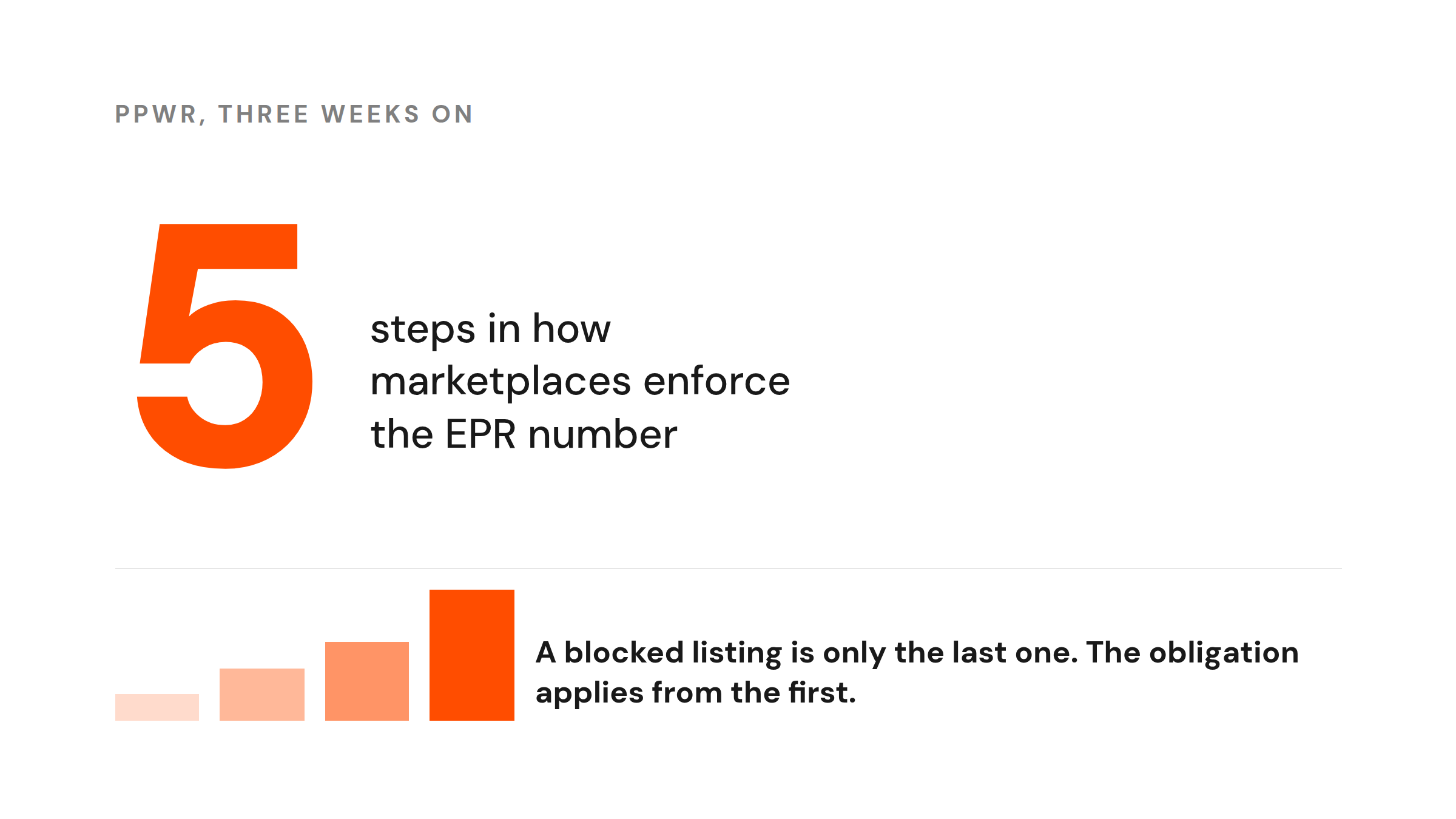
Sort that table by what actually happens to the seller and a scale comes out of it. A missing number has five different consequences today, depending on where you sell.

Status as of 2 September 2026
This is not an official position of the platforms. It is a snapshot of what we currently see on the accounts we manage. Marketplaces change their rules without notice, so a step can move overnight.
This is a separate obligation, distinct from the EPR registration itself, and it applies regardless of how fast any marketplace checks numbers.
Under Article 45 of the PPWR, since 12 August 2026 anyone supplying packaging or packaged goods to end customers in an EU country where they are not established must appoint an authorised representative there — separately for each country. For companies outside the EU the obligation applies with no delay and no exemption.
The European Commission did propose a deferral until 2035, but only for producers established in the EU selling cross-border into other Member States. Even that narrower proposal stalled in June 2026 when the Council closed the file. Relying on a deferral has no basis even for that narrower group.
The authorised representative is a separate legal relationship established by written mandate, under which the representative performs specific duties towards the authorities of that country: registration in the national register, reporting packaging data, paying the fees.
And because the register is public, it can be checked at any time — regardless of whether any particular marketplace has noticed. We covered it in detail in the article on when you need an authorised representative and where to find one, country by country.
The fact that marketplaces are not pulling listings across the board does not mean your situation is fine. It only means enforcement is lagging behind the legislation — mainly because the infrastructure in part of the EU is unfinished.
Once the registers catch up, marketplace enforcement can start quickly and without warning, the way it has been happening in Germany for years. And the authorised representative is not primarily enforced by a marketplace but by the state — and that obligation applies today.
Three steps for this week
1. List the countries where you supply end customers directly — those are the only ones that matter for Article 45. 2. For each one, find out whether you actually have a representative there, or only a registration and reporting. 3. Where registers are slow, above all Poland and Italy, start now; waiting times are measured in months, not weeks.
The legal part comes from the text of Regulation (EU) 2025/40 — the operative provision is Article 45(3) and the date of application is in Article 71. The deferral proposal is COM(2025) 982 of 10 December 2025; the Council closed the file on 24 June 2026.
Enforcement levels on individual marketplaces and the state of the national registers in Italy, Poland and the Netherlands are our own observations from client accounts, as of 2 September 2026. This is not legal advice — for the impact on your markets we recommend a legal consultation.
This topic follows on from the article on what Article 45 of the PPWR says and how to find a representative in nine countries.
Share this article on a social media.