The new €3 per item duty landed on the Asian platforms, not on retailers with EU-based stock. On goods under €25 it added 12 to 30 per cent to their costs. Where the competitive pressure eases, and how to use it in pricing, advertising and assortment.
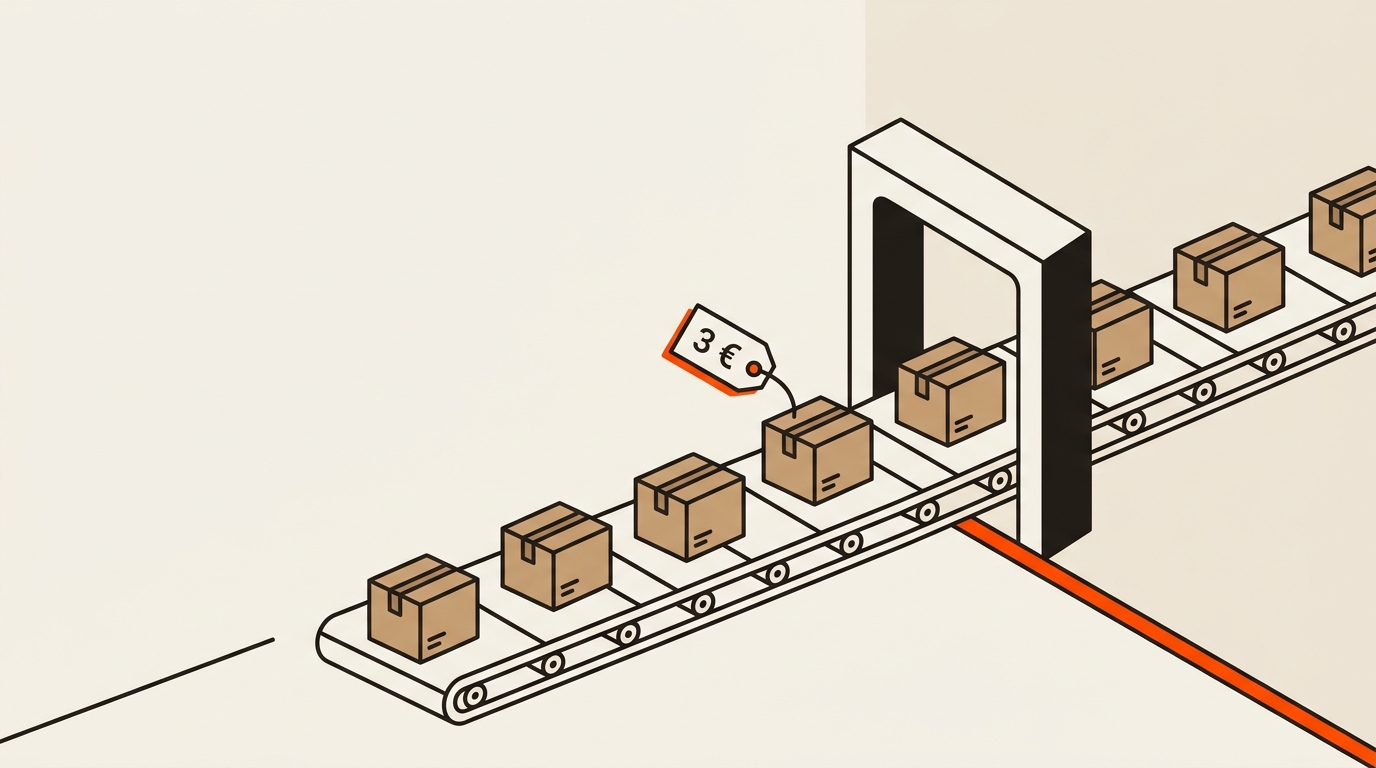
Short answer: if you sell from a warehouse inside the EU, the new duty does not apply to you. It is your Asian competition that got more expensive — and most of all on cheap goods, exactly where you could not compete on price before.
On 1 July 2026 the customs duty exemption for consignments under €150 from outside the EU ended. It was replaced by a flat duty of €3 per item on the customs declaration.
The word that matters is item. The charge is not per parcel but per customs code inside it. A parcel with five different small products therefore costs €15, not €3.
That is precisely the model Temu, Shein and AliExpress are built on: cheap, small, mixed parcels shipped straight to the end customer. Goods held in a warehouse inside the EU are not affected at all — the new rules do not change intra-EU shipments and VAT stays as it was.
30%
That is what a €3 duty amounts to on a €10 product. On a €150 product it is 2%.
The impact is easy to calculate: €3 divided by the product price. The cheaper the goods, the harder the hit for anyone bringing them in from outside.
| Product price | Duty per item | Share of price | What it means for a non-EU competitor |
|---|---|---|---|
| €10 | €3 | 30% | Either a significant price rise, or the item comes off the listing |
| €25 | €3 | 12% | Noticeable margin pressure, prices will move up |
| €60 | €3 | 5% | Absorbable, but they feel it |
| €150 | €3 | 2% | Practically unchanged |
What to do first
Filter your SKUs under €25 and compare their prices with your Asian competition. That is where the competitive field has shifted most — and where it shows up in your margin fastest. On more expensive goods, practically nothing has happened.
When the duty does apply to you
If you bring part of your assortment in from outside the EU in smaller consignments, or dropship directly from China to the customer, the duty applies to you as well. The answer is consolidation: on a €900 delivery with two customs codes the duty is €6, or 0.7% of the value. On five small items worth €60 it is €15 — a quarter. What makes the difference is the structure of the consignment, not its value.
The €3 duty is a transitional measure until 1 July 2028. The European Commission also expects to introduce a handling fee from 1 November 2026 at the latest — the amount is still being negotiated.
The direction of travel is clear: the price advantage of consignments from outside the EU will keep shrinking. Anyone holding stock inside the EU plays each further measure a little better.
The article draws on information published by the Czech customs administration, which summarises the EU rules: the removal of the duty-free threshold for low-value consignments and the €3 duty and other upcoming e-commerce changes. The impact calculation by price band is our own.
Status as of 12 August 2026. Implementing rules are still being added — for the specific impact on your assortment we recommend checking with a customs declarant.
The duty is not the only barrier that has narrowed the space for cheap imports. Extended producer responsibility pushes in the same direction, and so do VAT obligations under the One Stop Shop. For the wider picture, see our overview of marketplaces.
We manage sales across nine marketplaces and track category price movements for our clients continuously. Take a look at our complete management of marketplace sales, or get in touch — we will go through your categories with you and tell you where the pricing room has opened up.
Share this article on a social media.