Referral fees charged on VAT, a peak rate card from 15 October and storage 90% dearer. A full breakdown of FBA and FBM fees at September 2026 rates, plus a worked margin calculation on a single unit.
That question sits at the start of every decision about entering Amazon — and the answer is still the same: yes. Amazon remains the fastest route from Czechia to 200 million customers in Germany, France or Italy, without a branch, a warehouse or a sales rep there.
One thing has changed: margin is no longer made on Amazon, it is made in the spreadsheet — before you buy or manufacture the goods. Anyone who works it out in advance has the same chance as anyone five years ago. Anyone who goes by feel has it harder than they used to.
This article is about how to work it out.
The competition looks different. Five years ago the search results were mostly European sellers. Today you also stand next to a seller from Shenzhen with the same goods from the same factory, only without your distributor margin.
On top of that, Temu, Shein and AliExpress have shifted what the customer thinks a normal price is. The consequence is simple: there is less room for error in the calculation. A rough estimate used to cost you part of the margin. Today it can take all of it.
We see it on the accounts we take over. The typical finding: a fifth to a third of products are loss-making and the owner does not know, because the account as a whole is in profit. Switch those products off or reprice them and profit rises immediately — without a single extra euro in advertising. That is not bad news. It is the cheapest opportunity on the account.
Repricing against competitors and against a set minimum margin is handled by Autopricer. Finding loss-making products is the first step we start with in sales management.
Pricing strategy is similar. We hear: “we will go to zero for now, to hold position and collect reviews.” On one specific product and for a fixed period that can make sense.
As a permanent setting it does not, because a zero margin takes exactly what you need to grow: money for advertising, for better photos, for the next version of the product, for stock. Volume does not multiply a zero margin.
The good news is that all of this can be calculated in advance. Most fees are fixed by the rate card Amazon publishes, and the rest can be estimated from account history. When you know your numbers per unit, you can cut the price by 8% and know exactly what happens — and equally know when not to.
Calculate per product, not per account. The headline number in Seller Central will not tell you which products feed you and which cost you money.
Do not take on a fight you cannot win. Unbranded goods against a direct Chinese importer is a contest over who buys cheaper. It is not a defeat — it is simply a different discipline, and you do not have to enter it.
Sell goods that cannot be compared directly with anything else. Your own bundle, a different pack size, a different formulation, service in Europe, a longer warranty. Once your offer cannot be set one to one next to a competing one, price stops being the only criterion. European sellers have the advantage here, because they are closer to the customer and understand them.
Treat regulation as an advantage, not a nuisance. EPR, PPWR, GPSR or the duty to appoint an authorised representative raise costs for everyone — but more for Asian sellers than for you, because they have to handle it from the other side of the planet. Whoever has the obligations sorted earlier and more cheaply gains a cost advantage exactly when everyone else has to put prices up.
Start in a sensible category. For a new seller the rule is the same as ever: light goods, a low return rate, a decent margin already at purchase, no batteries and no hazardous goods. That gives you room to learn without the first mistake costing you a whole season.
To calculate, you have to know what you pay. Below is an overview of every fee an Amazon seller pays — separately for FBA and separately for self-fulfilment (FBM) — with current rates as at September 2026 and with the peak season changes marked. At the end there is a worked margin calculation on a specific order and a checklist for the fourth quarter.
The figures come from Amazon's official European rate card (Rate Card Europe, effective from 1 July 2026) and from the public pricing page sell.amazon.de. We write from the perspective of a European, and specifically a Czech, seller — we deliberately leave US rates out, because they differ from the European ones in a number of ways.
€39 a month excluding VAT for the professional selling plan, regardless of turnover. One plan covers all European markets within a single account.
The most important fee, and at the same time the one most often got wrong in the calculation.
Watch what it is charged on. Amazon sets the base as the total amount the buyer has to pay — that is, including the price of the goods and the cost of shipping and gift wrap. In practice that means you pay the referral fee:
On a product at €29.99 with German VAT of 19% you pay the referral fee on the full €29.99, not on the net €25.20. At a 15% rate that is a difference of €0.72 per unit — on ten thousand units a year, €7,200.
One exception: if Amazon accounts for the VAT itself as the deemed supplier — typically for sellers outside the EU — the referral fee is charged on the price excluding VAT.
Rates for the most common categories on amazon.de:
| Category | Rate |
|---|---|
| Computers, consumer electronics, large appliances, tyres | 7% |
| Games consoles | 8% |
| Beer, wine and spirits | 10% |
| Handmade, musical instruments and AV equipment | 12% |
| Tools and home improvement | 13% |
| Clothing and accessories | 5% up to €15 / 10% up to €20 / 15% above €20 |
| Household goods | 8% up to €20 / 15% above €20 |
| Beauty, health and personal care | 8% up to €10 / 15% above €10 |
| Food, supplements, pet food | 5% up to €10 / 15% above €10 |
| Furniture | 15% up to €200 / 10% above €200 |
| Electronics and computer accessories | 15% up to €100 / 8% above €100 |
| Jewellery, watches | 20% up to €250 / 5% above €250 |
| Kitchen, toys, sports, garden, pet supplies, office, footwear, books | 15% |
| Amazon device accessories | 45% |
| Everything else | 15% |
The minimum referral fee is €0.30 per unit (the minimum does not apply to books, music and film).
Good news: on 15 December 2025 and 5 January 2026 Amazon cut several rates — clothing from 8% to 5% (up to €15) and from 15% to 10% (€15–20), the new household goods category from 15% to 8% up to €20, and food and supplements from 8% to 5% up to €10. Amazon put the average impact across Europe at minus €0.17 per unit.
You pay for picking, packing and delivery. It follows the size tier and the weight. What matters is which column of the rate card you land in: Amazon has two different rates for Germany, depending on whether you are in the Central Europe Programme (CEP) or store only in Germany.
| Standard parcel, up to 45 × 34 × 26 cm | CEP (DE/PL/CZ) off-season | CEP in peak season | Germany only, off-season | Germany only, peak season |
|---|---|---|---|---|
| up to 900 g | €3.18 | €3.40 | €3.44 | €3.66 |
| up to 1.4 kg | €3.67 | €3.92 | €3.93 | €4.18 |
| up to 11.9 kg | €6.39 | €6.83 | €6.65 | €7.09 |
That €0.26 per unit is what joining CEP is worth. On five thousand units a year it comes to €1,300, and it costs nothing more than agreeing that Amazon may store the goods in Poland and Czechia. The rest of this article uses CEP rates, because those are the relevant ones for a Czech seller.
The peak uplift applies from 15 October 2026 to 14 January 2027 and means an increase of roughly 7% per unit. It is not a percentage surcharge — Amazon publishes a separate rate card for peak. It does not apply to clothing, oversized goods or the low-price rate card; the peak rate does not touch those at all.
On top of that comes a 1.5% fuel and logistics surcharge on all fulfilment fees. It has applied since 17 April 2026 on all ten European markets (Britain, Germany, France, Italy, Spain, Poland, Sweden, the Netherlands, Ireland, Belgium) and no end date has been announced.
The low-price rate card (Low-Price FBA): if you sell below €20 (below €12 for beauty, health, food, books and office supplies), you pay lower rates — the saving is roughly €0.45 per unit. From January 2026 the threshold rose from €12 to €20, so considerably more goods fit under it. Check whether you are sitting just above the threshold — cutting a price from €20.90 to €19.99 can pay off twice over: a lower rate and no peak surcharge.
This is where peak season bites hardest. Rates per cubic metre per month on amazon.de:
| Product type | January–September | October–December | Increase |
|---|---|---|---|
| Standard size — clothing, footwear, eyewear, handbags | €19.99 | €29.23 | +46% |
| Standard size — other categories | €27.54 | €52.20 | +90% |
| Oversized goods | €21.78 | €34.49 | +58% |
| Standard size — hazardous goods | €30.00 | €50.51 | +68% |
| Oversized — hazardous goods | €27.50 | €43.89 | +60% |
For ordinary categories storage almost doubles in the fourth quarter. Send in three months of stock in September and whatever does not sell is held at the most expensive rate of the year.
It rises very fast:
| Days in storage | Rate |
|---|---|
| 241–270 | €47.99 per m³ per month |
| 271–300 | €125.16 per m³ per month |
| 301–330 | €129.92 per m³ per month |
| 331–365 | €135.98 per m³ per month |
| 365–455 | €227.63 per m³ or €0.20 per unit (whichever is higher) |
| over 455 | €261.97 per m³ or €0.25 per unit (whichever is higher) |
Stock sent in for Christmas 2026 that does not sell reaches this band around June 2027. That is why in January it pays to liquidate or dispose of unsellable items rather than wait.
A fee for having too little stock. It applies to standard-size products fulfilled through the Pan-EU programme in Germany, France, Italy and Spain (not in the Netherlands, Poland, Sweden, Belgium or Ireland) once stock falls below 28 days of sales. Amazon charges it only when both the ninety-day and the thirty-day average are below 28 days.
| Days of stock cover | Fee per unit |
|---|---|
| 0–14 | up to €0.67 |
| 14–21 | up to €0.35 |
| 21–28 | up to €0.21 |
The exact rate depends on the size tier. In peak season, when sales accelerate and stock falls faster than you expect, plenty of sellers hit this fee without warning.
The refund administration fee. When you refund a customer, Amazon returns the referral fee — less the lower of the two amounts: €5, or 20% of the original referral fee. On an order of €29.99 with a 15% referral fee (that is €4.50) it comes to €0.90. The €5 cap only starts to apply on orders above roughly €167. It works the same for FBA and for self-fulfilment.
The returns processing fee. In two forms:
And above all: the fulfilment fee is not refunded on a return. You paid for the delivery and it is gone.
| Service (standard size, 0–200 g) | Germany |
|---|---|
| Return to the seller (domestic) | €0.50 per unit |
| Disposal | €0.74 per unit |
| Liquidation | €0.42 per unit + 15% of the proceeds |
| Cross-border removal, zone 1 | €0.60 per unit |
| Manual processing | €0.18 per unit |
| Labelling | €0.38–0.94 per unit |
| Polybagging | €0.53–0.86 per unit |
| Bubble wrap | €0.60–1.31 per unit |
Prep fees apply when goods arrive at the warehouse unprepared. On a single unit it is negligible; on a pallet it runs to hundreds of euros — and in peak season Amazon is stricter, because the warehouses are busy.
This is where the confusion is greatest. The Inbound Placement Service Fee exists only on the US market. It does not appear in Amazon's European rate card at all. If a tool or an article puts it into a European calculation, that calculation is wrong.
The European equivalent looks different:
That difference — €3.16 against €7.73 — is the real cost of inventory placement in Europe. And since 12 August 2026 you also have to count waste obligations and an authorised representative in every such country into it.
A passed-through digital tax. It is not charged on the price of the goods but on the fees you pay Amazon — that is, on the referral fee and on fulfilment fees. It does not apply to the monthly plan.
| Market | Rate | Note |
|---|---|---|
| France | 3% | raised from 2% on 20 March 2026 |
| Italy | 3% | raised from 2% on 20 March 2026 |
| Spain | 3% | raised from 2% on 20 March 2026 |
| Britain | 2% | |
| Germany, Poland, the Netherlands, Sweden, Belgium, Ireland | — | not charged |
| Canada | — | abolished on 15 August 2025 |
For a Czech company specifically: on 20 March 2026 Amazon moved from calculating by customer location to fixed rates based on the seller's place of establishment and the market. A seller established outside Britain, Italy and Spain pays 3% of the referral fee on amazon.fr, .it and .es, and on amazon.fr a further 3% of fulfilment fees. On amazon.de this fee is not charged at all.
It sounds like small change. But on €500,000 of turnover on the French market at an average referral fee of 15% it is €2,250 a year from referral fees alone — and you get nothing for it.
The difference between countries is large:
| Country | Amazon pays on your behalf | Cost of the service |
|---|---|---|
| France | yes | €24.99 per category per year + 3% of the waste contributions |
| Spain | yes | €24.99 per category per year + 3% of the waste contributions |
| Italy | yes | approximately €25 per category per year |
| Belgium | yes | approximately €25 per category per year |
| Britain | yes | £20 per category per year + waste contributions |
| Germany | no | you register yourself |
| The Netherlands, Poland, Sweden, Ireland | no | you register yourself |
Germany is the most demanding. Amazon takes nothing on for you and without a valid registration number it simply switches your listings off. You have to arrange yourself:
Processing takes 12 to 14 weeks, so registration is among the first things to arrange when entering the German market — ideally a quarter before you plan your first sale.
On top of that, since 12 August 2026 there is a duty to appoint an authorised representative for EPR in every EU member state where you sell to end customers and have no establishment. It applies to Czech companies too. We covered it in detail in the article You now need an authorised representative for EPR in every country you sell into.
Two things that get confused most often: Amazon paying on your behalf does not replace your registration and an EPR service provider is not automatically your authorised representative.
Self-fulfilment looks cheaper at first glance — no fulfilment fee, no storage fee, no low-inventory fee and no aged inventory surcharge. Except:
1. You pay the referral fee on shipping too. This is the most expensive trap. Set shipping at €4.99 and Amazon adds it to the price of the goods and charges the referral fee on the whole amount. At 15% the shipping alone costs you an extra €0.75 on every order. Free shipping with the price raised by the same amount comes out exactly the same — there is nothing to save here.
2. You pay the referral fee on VAT too. The same as with FBA.
3. Real shipping from Czechia to Germany costs more than Amazon's fee. A parcel up to one kilogram with tracking and delivery in two to three days costs €5 to €7. Amazon does the same for €3.18, because its volumes are different.
4. Returns cost more than they look. A customer in Germany has the right to return the goods and the return carriage is on you. The return shipment to Czechia alone costs €5 to €7. On top of that comes:
On an order of €35 that adds up to roughly €7.50 of direct return costs, and with the lost outbound postage you reach €13. That is why with self-fulfilment it pays to watch the return rate product by product — two or three problem items can eat the profit of an entire category.
5. Your metrics are monitored. Late shipment rate, valid tracking rate, order defect rate. One bad stretch in peak season and you lose the Buy Box, or the account outright.
6. Buy Box and conversion. An offer with the Prime badge converts markedly better, especially in December, when the customer is working out whether the goods will arrive by Christmas Eve.
When self-fulfilment makes sense: bulky and heavy goods, slow-moving items, made-to-order production, an expensive range with a low return rate — and as a backstop in case you run out of stock in Amazon's warehouse during peak season.
The model product: a kitchen accessory, amazon.de, selling price €29.99 including VAT, kitchen category (15% referral fee), standard parcel up to 900 g, dimensions 20 × 15 × 10 cm (0.003 m³), cost price €8.00, volume 500 units a month, seller enrolled in CEP.
| Item | Off-season | Peak season |
|---|---|---|
| Price paid by the customer (incl. 19% VAT) | €29.99 | €29.99 |
| − 19% VAT | −€4.79 | −€4.79 |
| = Net revenue | €25.20 | €25.20 |
| − Referral fee 15% (on €29.99, i.e. including VAT) | −€4.50 | −€4.50 |
| − Fulfilment (€3.18 / €3.40 + 1.5% surcharge) | −€3.23 | −€3.45 |
| − Storage (2 months, 0.003 m³) | −€0.17 | −€0.31 |
| − Returns provision (5% / 8%) | −€0.31 | −€0.52 |
| − Advertising (cost share 15% / 22%) | −€4.50 | −€6.60 |
| − Monthly plan (€39 / 500 units) | −€0.08 | −€0.08 |
| Total Amazon fees | −€12.79 | −€15.46 |
| − Cost price of the goods | −€8.00 | −€8.00 |
| − Inbound freight to the warehouse | −€0.45 | −€0.45 |
| − Waste fees and packaging material | −€0.10 | −€0.10 |
| Total cost of goods | −€8.55 | −€8.55 |
| PROFIT PER UNIT | €3.86 | €1.19 |
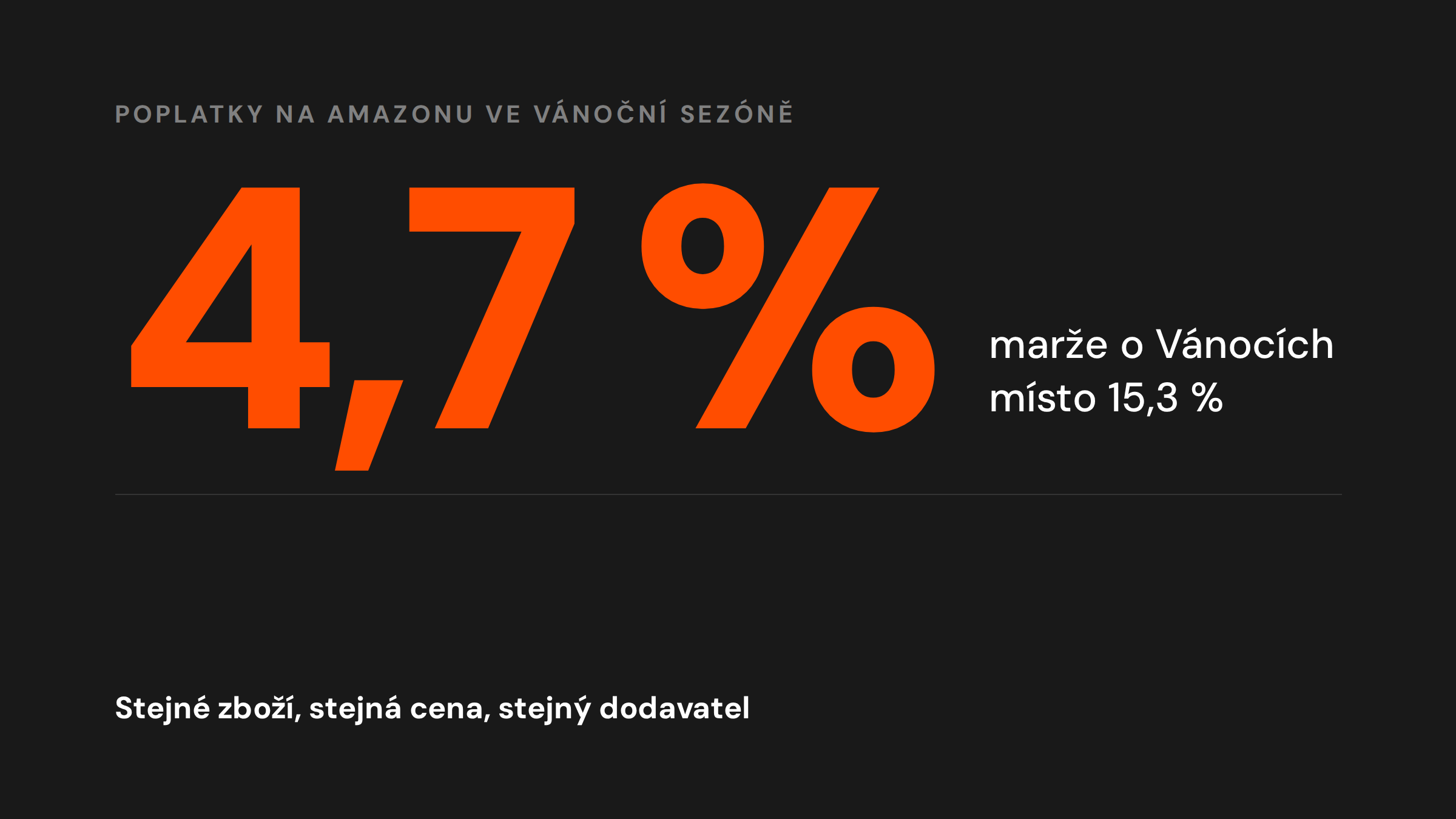
| Margin on net revenue | 15.3% | 4.7% |
Same product, same price, same supplier — and the difference between a margin of 15.3% and 4.7%.
The difference of €2.67 per unit is made up of four items: fulfilment +€0.22 (peak rate card), storage +€0.14, advertising +€2.10 and the returns provision +€0.21. Advertising is three quarters of that — Amazon's peak fees are small by comparison.
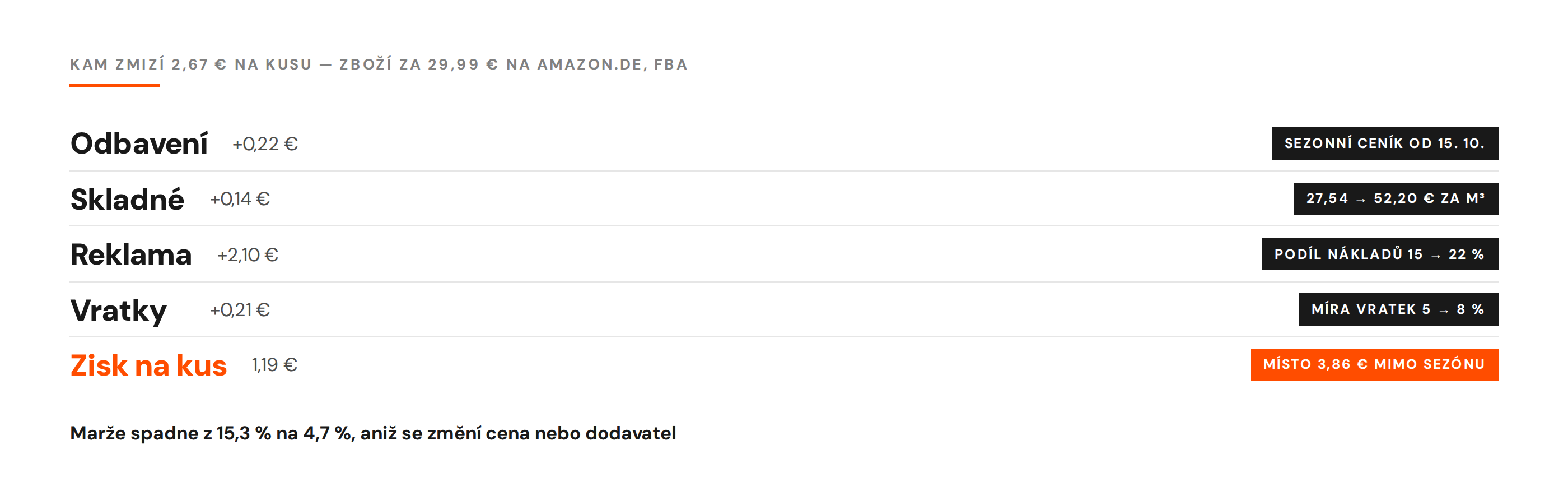
This is not a reason to skip the peak season, quite the opposite: it sells several times the normal volume. It is a reason to set a different price and a different advertising budget for November and December than you run in May. Do it in September and you earn. Work it out in December and you shift the volume at minimal profit.
A note on the returns provision: we use 5%, or 8% in peak season. Every return costs the unrefunded fulfilment fee, the refund administration fee (€0.90) and repacking. A fifth of returned goods cannot be sold again.
What can be done? For the product to hold a 15% margin in peak season too, you need one of these:
So the price route drops out in practice: the competition will not let you be a quarter more expensive. The first option is the most achievable — but only if you build the organic position in August and September. In November the same spot in the results is markedly more expensive.
| Item | Amount |
|---|---|
| Price of the goods | €29.99 |
| + Shipping charged to the customer | €4.99 |
| = Total paid by the customer | €34.98 |
| − 19% VAT | −€5.58 |
| = Net revenue | €29.40 |
| − Referral fee 15% on €34.98 (of which €0.75 on the shipping alone) | −€5.25 |
| − Real shipping from Czechia to Germany | −€5.90 |
| − Packaging and labour | −€0.35 |
| − Advertising (cost share 15%) | −€5.25 |
| − Monthly plan | −€0.08 |
| − Returns provision (5%) | −€0.75 |
| − Cost price of the goods | −€8.00 |
| − Waste fees and packaging | −€0.10 |
| Total costs | −€25.68 |
| PROFIT PER UNIT | €3.72 |
| Margin on net revenue | 12.7% |
A note on the returns provision: we use a 5% return rate. Every return costs the return carriage to Czechia (€6), the refund administration fee (€1.05), repacking (€0.50) and the lost outbound postage (€5.90). A fifth of returned goods cannot be sold again.
So self-fulfilment ends at 12.7% against 15.3% for FBA off-season — and in peak season it is relatively better off, because it pays neither the peak surcharge nor the doubled storage fee. But it sells markedly fewer units, because it has no Prime badge in the period when the customer is working out delivery before Christmas Eve.
The most important number in that table is €0.75. That is the referral fee on the shipping you collected from the customer and passed on in full to the carrier. A pure loss that most self-fulfilling sellers do not know about.
By the end of September:
October:
November and December:
January:
There are more fees than five years ago and the obligations keep growing — that is a fact. At the same time every rate is public, known in advance and can be calculated per unit. That cannot be said of most offline businesses.
Amazon is still the simplest way to reach Western European markets from Czechia. What has moved is where success is decided: not in whether the goods “will sell”, but in whether they work out in the spreadsheet before you buy or manufacture them.
When they do, it works. And it works well.
On the model product at €29.99 with FBA it comes to €12.79 off-season, roughly half the net revenue. In peak season €15.46. The largest items are the referral fee (€4.50), advertising (€4.50 to €6.60) and fulfilment (€3.23 to €3.45).
On the price including VAT. Amazon takes as the base the whole amount the customer pays, including the tax, the shipping and the gift wrap. On a product at €29.99 with German VAT, at a 15% rate that is €0.72 per unit more than a calculation on the price excluding VAT. The exception is transactions where Amazon accounts for the VAT itself as the deemed supplier — there it is charged on the price excluding tax.
From 15 October 2026 to 14 January 2027 the peak fulfilment rate card applies, which is roughly 7% higher (for a standard parcel up to 900 g that is +€0.22). From October to December storage for ordinary categories rises from €27.54 to €52.20 per m³, that is by 90%. The peak fulfilment rate does not cover clothing, oversized goods or the low-price rate card.
In the worked calculation FBA comes out at a margin of 15.3% and self-fulfilment at 12.7%. The difference is mainly that Amazon delivers a parcel in Germany for €3.18, while the same thing from Czechia costs €5 to €7. Self-fulfilment makes sense for bulky and heavy goods, for slow-moving items, for made-to-order production and as a backstop when stock runs out in peak.
No. The Inbound Placement Service Fee is a US fee and is not in Amazon's European rate card. The European equivalent is different rates by programme: through EFN you pay €7.73 for a standard parcel up to 400 g against the local CEP rate of €3.16.
In Germany Amazon does not take on the waste obligations. You have to arrange the packaging registration yourself (VerpackG, the LUCID register and a contract with a dual system), Stiftung EAR for electrical equipment and a BattG registration for batteries. Processing takes 12 to 14 weeks and without a valid registration number Amazon switches the listings off. Since 12 August 2026 there is also a duty to appoint an authorised representative in every EU member state where you sell and have no establishment.
All the rates in this article are taken from Amazon's official European rate card (Rate Card Europe, effective from 1 July 2026) and from the public pricing page sell.amazon.de, verified on 21 September 2026. The worked margin calculations are our own, built on those rates and on typical values from the accounts we manage. Amazon changes its rate cards several times a year and rates differ between markets — check the current numbers in your own Seller Central before you decide.
Share this article on a social media.